

/ Jana Winkler
ERC Consolidator Grant for Professor Ivan Dokmanić: New Foundations for Scientific Machine Learning
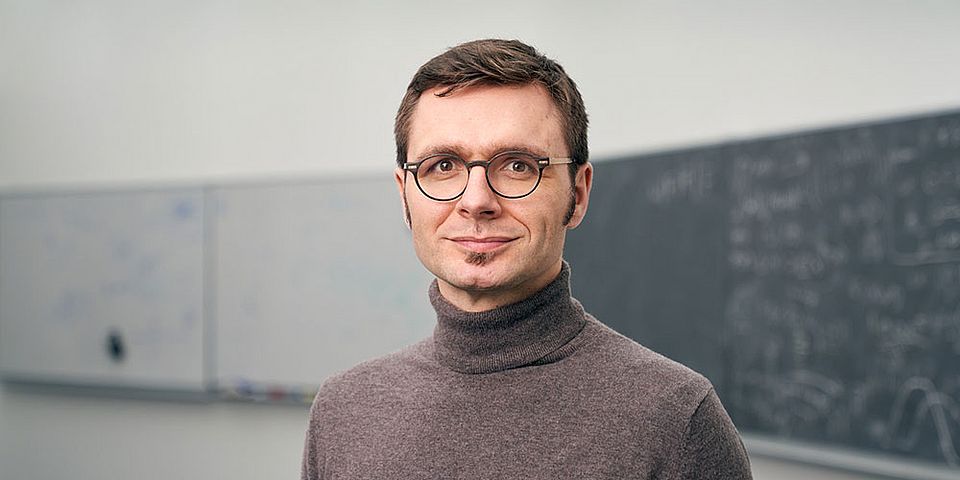
Professor Ivan Dokmanić from the Department of Mathematics and Computer Science at the University of Basel has been awarded a prestigious ERC Consolidator Grant for his research project PHASESHIFT – Phase-Space Foundations for Scientific Machine Learning. The grant is among the most competitive distinctions in the European research landscape and supports a five-year programme aimed at fundamentally rethinking the foundations of AI methods for scientific applications.
Professor Dokmanić’s research team highlights the growing importance of transparent and reliable neural networks. Scientific Machine Learning (SciML) now plays a central role in areas such as medical imaging, climate modelling, materials science, and Earth system research. Despite impressive progress, current AI models face substantial challenges: they require large datasets, extensive computational resources, and often behave like black boxes.
PHASESHIFT directly addresses these issues. The project investigates how universal Hamiltonian structures and phase-space locality can be leveraged to significantly improve sample efficiency and Lipschitz stability compared to existing network architectures. In addition, the project aims to develop a new generation of interpretable surrogate models that go far beyond classical PDE-based physics. Another goal is to systematically explore the role of scaling in data and physical processes.
Research Objectives
PHASESHIFT is structured around four strategic research objectives that together aim to establish a new foundation for Scientific Machine Learning:
Microlocal phase spaces for inverse problems and neural operators
Instead of letting AI learn directly from images or raw measurements, PHASESHIFT explores a different mathematical space where complicated physical processes become easier to describe. This could make AI tools more reliable, require less data, and open the door to better methods for imaging, waves, and dynamic systems.
Discrete kinetic phase spaces as a basis for general physics models
Today’s AI models often try to mimic existing physics equations. PHASESHIFT takes a more ambitious route: it builds AI systems inspired by how particles behave in gases and fluids. This could enable models that describe physical processes even when no established equations exist, paving the way for a new generation of transparent, broadly applicable science models.
Modelling scale interactions in space and time
Many real-world phenomena, from storms to earthquakes, depend on interactions happening at many different sizes and speeds at once. PHASESHIFT aims to develop AI tools that inherently understand these layered interactions, enabling more accurate predictions with far less data.
Applications in imaging and Earth science
The project tests its ideas in three challenging areas: producing sharper images of biological structures, analyzing seismic data from multiple stations, and modelling natural hazards such as landslides and avalanches. These examples demonstrate how the project’s methods can support both scientific discovery and societal needs.
Broader Impact
PHASESHIFT aims not only to advance methodology but also to have a broader impact. The researchers seek to help demystify complex scientific tools by making models more transparent and interpretable. At the same time, the project positions itself as a counterpoint to the so-called Bitter Lesson, which claims that raw computational power often outperforms clever algorithmic design. PHASESHIFT demonstrates that thoughtfully structured models can unite both efficiency and interpretability. Moreover, the phase-space concept holds promise for neighboring disciplines such as quantum physics, optimization, and robotics.
With the support of the ERC, this research programme now has the resources needed to systematically explore these perspectives and drive long-term innovation in Scientific Machine Learning.
For more information, please see the Uni News: https://www.unibas.ch/en/News-Events/News/Uni-People/ERC-Consolidator-Grants-2025-University-of-Basel.html