

Susanna Zimmermann awarded the Latsis Swiss Science Prize
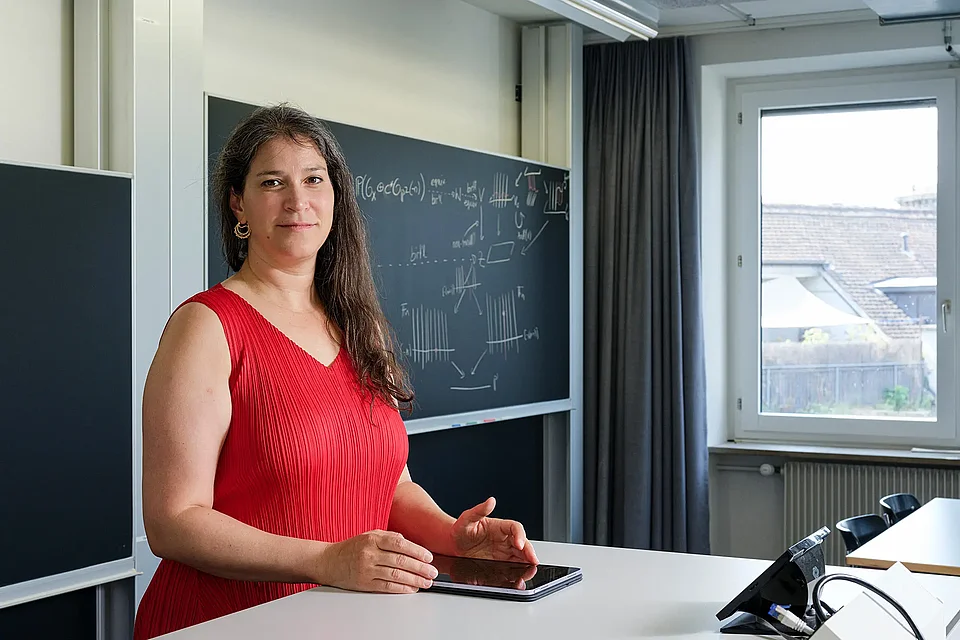
The Latsis Swiss Science Prize has been awarded to mathematician Susanna Zimmermann for her pioneering research on the symmetries of geometric spaces, which enabled her to resolve a question in algebraic geometry that had remained open since the 19th century. Biochemist Martin Jinek receives the prestigious Swiss Science Prize Marcel Benoist for his groundbreaking discoveries on cellular processes that paved the way for the breakthrough of genome editing.
Mathematician Susanna Zimmermann is a professor at the University of Basel and conducts research in the field of algebraic geometry. In particular, she studies the symmetries of geometric spaces and their underlying mathematical structure. Together with Jérémy Blanc and Stéphane Lamy, she achieved a significant breakthrough: working on so-called Cremona groups, the researchers were able to resolve a question that had remained open since the 19th century and show that these groups possess a rich internal structure. Susanna Zimmermann’s research contributes to a better understanding of the fundamental properties of mathematical spaces and opens up new connections between different areas of mathematics. Susanna Zimmermann is now being awarded the Latsis Swiss Science Prize, which is presented to early-career researchers with an academic age of up to ten years and comes with prize money of CHF 100,000.
Martin Jinek receives the prestigious Swiss Science Prize Marcel Benoist
With prize money of CHF 250,000, the Swiss Science Prize Marcel Benoist is regarded as the “Swiss Nobel Prize.” This year’s laureate, Martin Jinek, is Professor of Biochemistry at the University of Zurich. He is being honoured for his outstanding research on RNA-guided molecular systems that can specifically target the genetic material of cells, as well as their application in genome editing. Together with other researchers, Martin Jinek played a key role in developing the natural CRISPR-Cas9 system into a programmable tool for the targeted modification of DNA. This work gave rise to CRISPR-Cas9 genome-editing technology, also known as “genetic scissors,” which earned Jennifer Doudna and Emmanuelle Charpentier the 2020 Nobel Prize in Chemistry. Through his research, Martin Jinek is deepening our understanding of molecular biological processes and opening up new approaches in a wide range of applications, including biomedicine (gene therapy), biotechnology and innovative agriculture.
Award ceremony at the Parliament Building
The scientific selection of the two laureates was carried out by the Swiss National Science Foundation (SNSF) on behalf of the Marcel Benoist Foundation and the Fondation Latsis. The joint award ceremony for the Swiss Science Prizes will take place on 5 November 2026 at the Federal Palace in Bern. The presidents of the respective foundations will present the prizes in the presence of Swiss President Guy Parmelin and President of the Council of States Stefan Engler.