

«WhAI Study» in the Age of AI?
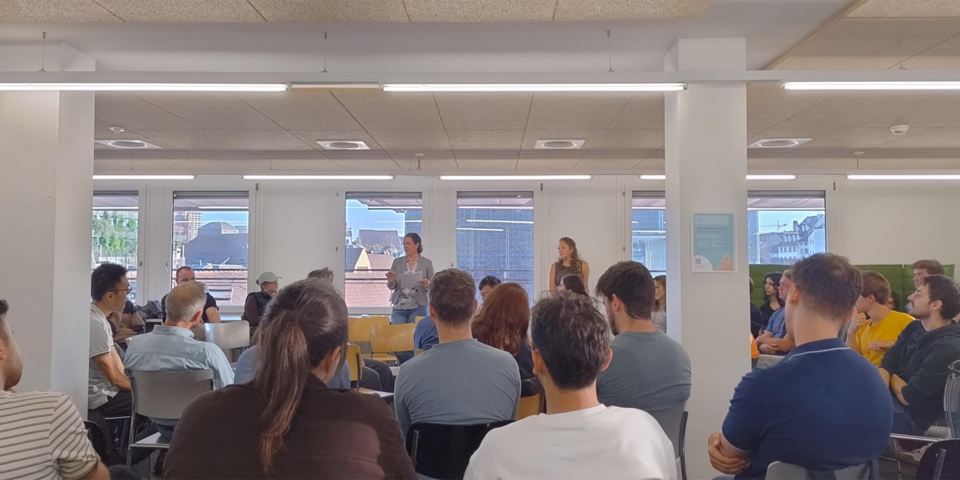
What’s the point of studying computer science or mathematics if AI is taking over? What does teaching look like in the age of AI? What skills do graduates need today, and how can they best prepare for the workforce? The «WhAI study» discussion forum focused on precisely these questions.
Moderated by Bianca Bärlocher and Marc Frick, students and faculty discussed what a meaningful approach to artificial intelligence might look like in their academic studies. Participants in the discussion included Filipa Lüthy (a student of mathematics and philosophy), Marcel Lüthi (a computer scientist and lecturer at ETH Zurich), David Zhang (a computational biologist at Roche and adjunct lecturer at the University of Basel), Birgit Müller (director of the Career Service Center at the University of Basel and a psychologist), as well as various speakers from the audience.
Learning success is more than just a good result
One key insight was that, when it comes to studying, it’s not just the result that counts. Learning is a process, and that includes grappling with difficult problems, taking detours, and even failing sometimes. While AI can support this process, it cannot replace it. The key question, therefore, is how AI is used. Ideally, it can help students truly understand a concept and reach that exact moment when it «clicks». For this to happen, however, students need not only technical skills in using AI but also the ability to critically evaluate its answers.
A vivid comparison from the discussion summed it up perfectly: Anyone who lets AI handle all their tasks is behaving a bit like someone who uses a forklift to lift weights at the gym. You might lift the same number of kilograms, but you won’t get any stronger as a result.
Transparency on both sides
A recurring request from students was for more clarity on when and how AI may and should be used in their studies. For them, this is not just about rules. Students want to be able to clearly explain how they use AI in their work. At the same time, they are interested in how faculty members themselves use these new tools: Which applications do they use? Where do they see added value, and where do they draw the line? This means that faculty members are important role models. They not only impart subject-matter expertise but can also set an example of a reflective and critical approach to AI.
Personal interaction remains irreplaceable
Especially in a learning environment increasingly shaped by AI, the discussion made it clear just how important the human aspect of higher education remains. The relationship between students and faculty, interaction with fellow students, motivation, and personal guidance cannot be automated. After all, studying means more than just producing the right answers as efficiently as possible. It means wanting to understand, asking questions, thinking through problems together, and truly acquiring new knowledge. AI can serve as a tool in this process, but the actual work of learning remains the responsibility of the students. Accordingly, smaller discussion groups and more opportunities for direct interaction were also cited as important approaches. The idea of a university-supported AI tutor was also discussed; the goal of such a tutor would not be to provide solutions as quickly as possible, but rather to guide students through the learning process in a targeted manner.
The discussion should continue
The «WhAI study» shed light on many questions raised by students and, at the same time, showed that the answers to these questions are only just beginning to emerge and are still evolving.
The forum is therefore not intended to be the final word on the matter. The discussions should give rise to further opportunities for exchange between students and faculty. After all, if AI is changing the way we study and teach, this change should not be shaped solely for students, but together with them.